
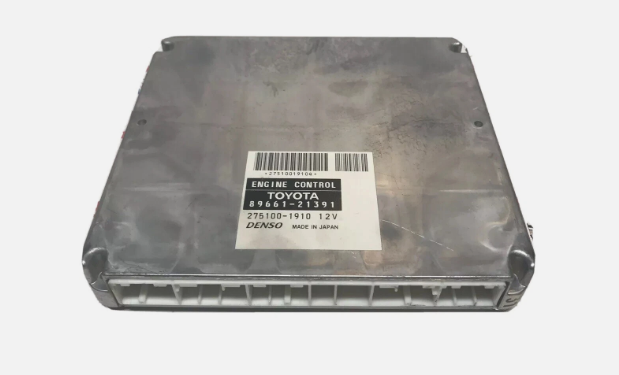
K-LINE and CAN bus ECU
-
- 2005/2006 Scion tC is a K-Line (or K-band) ECU
- 2007-2010 Scion tC is a CAN bus ECU
The difference between a K-line ECU and a CAN bus ECU comes down to how the ECU communicates with the rest of the vehicle and diagnostic tools. They represent two different generations of automotive network technology.
K-line ECU (2005/2006 Scion tC)
K-line is a single-wire serial communication standard (ISO 9141 / ISO 14230, often called KWP2000).
Key characteristics:
- One main communication wire (slow data rate)
- Primarily used for OBD-II diagnostics only
- ECU talks directly to a scan tool, not other modules
- Limited data bandwidth
- Common on late-1990s to mid-2000s vehicles
What this means in practice:
Slower scan tool response, Fewer live data parameters, Aftermarket tools and tuning options are more limited, Simple electrical architecture.
CAN bus ECU (2007-2010 Scion tC)
CAN (Controller Area Network) is a high-speed, two-wire differential network used to connect all vehicle modules.
Key characteristics:
- Two twisted wires (CAN High and CAN Low)
- High data rate and robust error handling
- ECU communicates with ABS, body control, airbags, cluster, etc.
- Supports advanced features like traction control, stability control, and drive-by-wire
- Standard on most vehicles from ~2008 onward
What this means in practice:
Faster diagnostics and more live data, More complex tuning (security, gateways, encryption), Modules are interdependent (removing one can cause faults), Enables modern features and safety systems.
Quick comparison for Scion tC owners
| Feature | 2005–2006 tC | 2007–2010 tC |
|---|---|---|
| ECU Communication | K-line | CAN bus |
| Scan Speed | Slow | Fast |
| Electrical Complexity | Low | Higher |
| Tuning Difficulty | Easier | Harder |
| DIY Friendliness | High | Moderate |
Scion’s ECU is aggressively adaptive by design
Tuning the Scion tC ECU is frustrating mainly because Toyota designed the ECU to constantly “correct” itself. Even when you make tuning changes, the ECU’s relearn logic can slowly erase or override them.
Here’s what’s really going on 👇
The 2005–2010 tC uses a closed-loop, self-learning ECU that prioritizes:
- Emissions compliance
- Engine safety
- Long-term reliability
To do that, it constantly adjusts:
- Fuel trims (STFT & LTFT)
- Idle airflow
- Throttle behavior (drive-by-wire)
- Knock correction and ignition timing
So instead of “obeying” a tune, the ECU asks:
“Does this match what my sensors say should be happening?”
If not—it corrects it.
The relearn process actively rewrites learned values
Whenever certain conditions occur, the ECU resets learned data and starts relearning from scratch.
Common triggers:
- Battery disconnect
- ECU reset / flashing
- Dead battery
- Clearing codes
- Sometimes just extended driving in new conditions
What gets relearned:
- Idle air control behavior
- Throttle opening vs airflow
- Fuel trims
- Knock thresholds
That means:
Your tuning edits may work briefly… then fade away.
Fuel trims can “undo” fueling changes
Even if you alter fueling with:
- Piggyback controllers
- MAF signal manipulation
- Mild ECU reflashes
The ECU watches the O₂ sensors and says:
“I don’t like this AFR.”
Then it:
- Adds or removes fuel via LTFT
- Gradually brings AFR back toward stock targets
- Stores that correction permanently (until reset)
Result:
✔ Car feels better for a few drives
❌ Then slowly reverts toward OEM behavior
What is STFT and LTFT?
LTFT is the ECU’s learned fuel correction over time. It represents how much fuel the ECU is adding or subtracting from the base fuel map to hit its target air-fuel ratio (AFR).
-
Positive LTFT (+%) → ECU is adding fuel (engine running lean)
-
Negative LTFT (–%) → ECU is removing fuel (engine running rich)
Unlike STFT (Short-Term Fuel Trim), which reacts instantly, LTFT is a memory value that the ECU builds based on repeated STFT behavior under similar conditions (idle, cruise, light load).
Throttle & idle relearn fights drivability mods
The tC ECU has a throttle/idle relearn routine that:
- Learns how much throttle opening = stable idle
- Adapts to engine wear, vacuum changes, and airflow mods
When you add:
- Intake, short ram or cold air
- Throttle body
- Lightweight flywheel
- Vacuum changes
The ECU may:
- Relearn a softer throttle response
- Reduce initial throttle opening
- Change idle behavior back to “safe” values
This is why throttle response mods often feel inconsistent. This is why MANY people with experience on the 1st Gen Scion tC say that adding a intake does virtually nothing for performance.
Knock control is conservative and sticky
Toyota knock logic:
- Retards timing quickly
- Restores timing very slowly
- Stores learned knock correction
If your tune advances timing:
- One knock event can trigger retard
- ECU may keep that reduced timing indefinitely
- Especially true on lower-octane fuel
So even a good timing tune can get “trained out” over time.
Why this makes tuning the 2005–2010 tC hard
In short:
- The ECU is always learning
- Learning survives key cycles
- Learning can override tuning logic
- Relearn events reset the ECU’s memory
- The ECU reverts toward emissions-safe behavior
This is why:
- Piggybacks feel temporary
- Flash tunes struggle without deep ECU access
- Consistency is hard to maintain
Practical takeaway
To tune these cars successfully, you need one of the following:
- Full ECU control (rare, expensive, limited support)
- Forced induction (forces ECU out of comfort zone)
- Standalone ECU (best control, most work)
- Or accept small, reversible gains
ECU Tuners
I’m only aware of a few ECU tuners for the 2005-2010 Scion tC. Keep in mind the charateristics I described above when considering an ECU tune:
AMT TUNING
Stage 1 consists of an individual reprogramming of the engine management system of the vehicle, whereby the adjustment of the engine parameters (e.g. ignition, injection, throttle response, torque limiters etc…) are customly adjusted. All engine parameter values at this stage remain within the safety standards prescribed by the manufacturer. Stage 1 is 100% reliable and emission compliant
Stage 2 requires aftermarket parts to enhance the intake and exhaust flow capabilities of the vehicle and provide a less restrictive path. The required parts are cold air intakes, headers (either catless or high flow) and an upgraded exhaust system. The stage 2 tune is reconfigured to account for the improved airflow. Please email or call us for recommendation on part selection!
- Throttle Response Improved
- Decat (rear O2 delete) included in Stage 2
- Rev Hang Improved
- RPM Limiter set @ 6800
- Optimized for 91- 93 Octane
- Top Speed (Governor) Removal
- Improved Fuel Efficiency
- ECU individually reprogrammed
- Optimized Responsiveness and Drivability
- Datalog analysis
* Software Available:
1. Stage 1 (89/91 Octane) – Requires K&N Drop in Filter
2. Stage 1 with Pops & Bangs (89/91 Octane) – Requires K&N Drop in Filter & Catback Exhaust3. Stage 2 (91/93 Octane) – Requires Cold Air Intake & Catback Exhaust
4. Stage 2 with Pops & Bangs (91/93 Octane) – Requires Cold Air Intake & Catback Exhaust5. Stage 2+ (91/93 Octane) – Requires Cold Air Intake, Catback Exhaust optimized Headers
6. Stage 2+ with Pops & Bangs (91/93 Octane) – Requires Cold Air Intake, Catback Exhaust optimized Headers
DYNO CENTER TUNING LLC
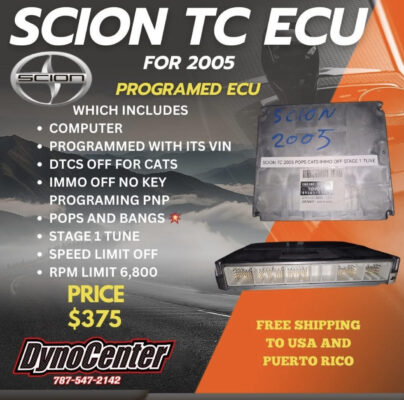
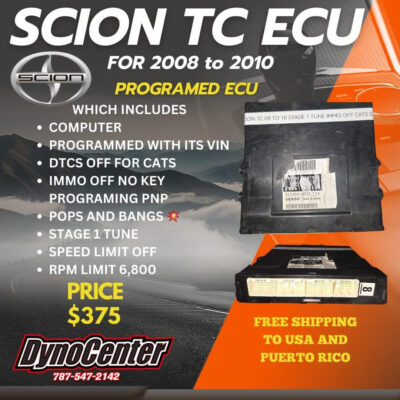
SNP_REFLASH
Hi them up on Instagram for more info!
Reddit Article: https://www.reddit.com/r/SciontC/comments/1q7mixl/gen_1_tc_tuning_is_here/
