
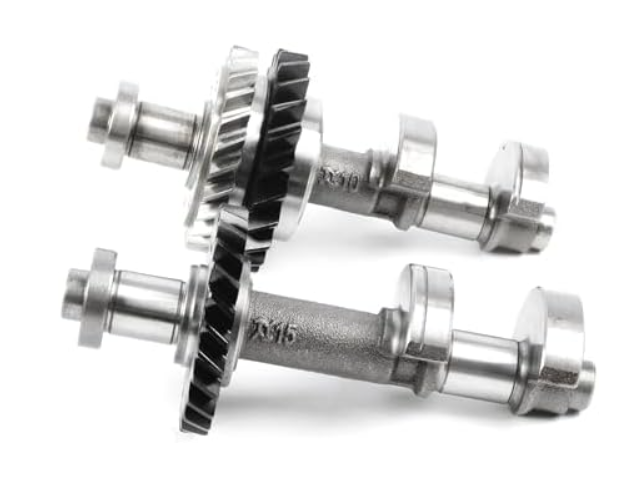
Part Numbers
- Balance Shaft #1 – 13601-28031
- Balance Shaft #2 – 13602-28030
- Balance Shaft Seals (need QTY8) – 11911-28011-02
Key Details on Scion tC Balance Shafts
- Function: The 2.4L 4-cylinder engine utilizes dual balance shafts rotating in opposite directions at twice the crankshaft speed to eliminate second-order vibration.
- Symptoms of Failure: Worn bearings or faulty installation can lead to severe engine vibration, rough idling, rattling noises, and potential oil pressure loss.
- Replacement/Repair: When replacing, ensure the bearings are installed to precise tolerances.
- Alignment (Timing): During engine rebuilding, the crankshaft must be at top dead center (12 o’clock position), and the balancer shafts’ marks (dots/lines) must be aligned with the corresponding marks on the block and crankshaft to avoid intense vibrations.
- Delete Kits: Some performance users opt to “delete” the balance shaft module (often found on 2.4L/2.5L engines) to reduce rotational mass and improve throttle response, though this results in significantly higher engine vibration.
What a Balance Shaft Delete Actually Is
A balance shaft delete means removing or disabling those shafts in the engine block and then blocking the oil feed that would normally lubricate them. On the 2AZ-FE this is typically done by:
-
Removing the balance shaft assembly (usually from the oil pan/timing cover area).
-
Blocking off the oil galley that feeds the balance shaft bearings (often with a tapped set screw or plug).
-
Reassembling the engine without the shafts.
There are some aftermarket “delete kits” that try to make this cleaner by replacing bearings and installing proper block-off pieces rather than just jamming screws in holes.
Why Some People Do It
Perceived Benefits
-
Less mechanical drag: With the rotating balance shafts gone, there’s theoretically slightly less friction and inertia for the engine to overcome. Some enthusiasts claim a very small increase in throttle responsiveness or rev speed.
-
Simplifies timing assembly: For some builds (like forced induction or high-rev builds), members sometimes remove the shafts to reduce part failure points during high load.
-
Clean up clatter: On older engines where balance shaft bearings are worn or noisy, removing them can eliminate chatter from that area.
Trade-Offs / Downsides
-
Increased vibration: Without the balance shafts, the engine can feel rougher, especially at certain RPMs or idle.
-
NVH goes up: Cabin noise and shake may be more noticeable — especially in a car not originally designed for this.
-
Debate over wear & oiling: There’s some disagreement in the community about whether blocking the oil feed properly is important and how the change affects oil pressure and lubrication paths.
-
Minimal performance gain: Any power or responsiveness gain is usually very small and mostly noticeable only on dyno or sensitive measurement — not dramatic on the street.
-
Engineering intent: Toyota put balance shafts in for a reason — smoothness and engine longevity — so removing them goes against factory design.
Real-World Experiences
Owners who’ve done this mod on 2AZ-FE engines (including on Scion tC and Toyota xB variants) report:
-
Very occasional increases in smoothness if the original shafts were worn or noisy.
-
Some feel like rev response is a bit sharper with less rotating mass, but this is a subtle change.
-
Others caution on ensuring no metal shavings or debris remain when tapping/blocking oil feed — even small bits can damage bearings.
Should You Do It?
Generally:
If your goal is aggressive performance gains on a stock engine, a balance shaft delete alone won’t move the needle much. It’s more commonly considered in conjunction with other engine work (built bottom end, forced induction, etc.). Removing them purely for “more power” on a stock tC won’t give you dramatic results.
If your engine’s balance shafts are failing:
In cases where the balance shaft bearings are worn, some enthusiasts do a delete as a functional fix rather than reinstalling new shafts.
Additional Resources
Toyota Nation – https://www.toyotanation.com/threads/balance-shaft-delete-without-plugging-oil-feed.1675207/
RAV4 World – https://www.rav4world.com/threads/balance-shaft-delete-results.298787/
Reddit – https://www.reddit.com/r/SciontC/comments/163t0cs/balance_shaft_delete_done/
YouTube – https://www.youtube.com/watch?v=BW0MVgIXHeA
